
Does Her Body Know When It Is Safe? Autoimmunity Through a Psychosomatic Lens
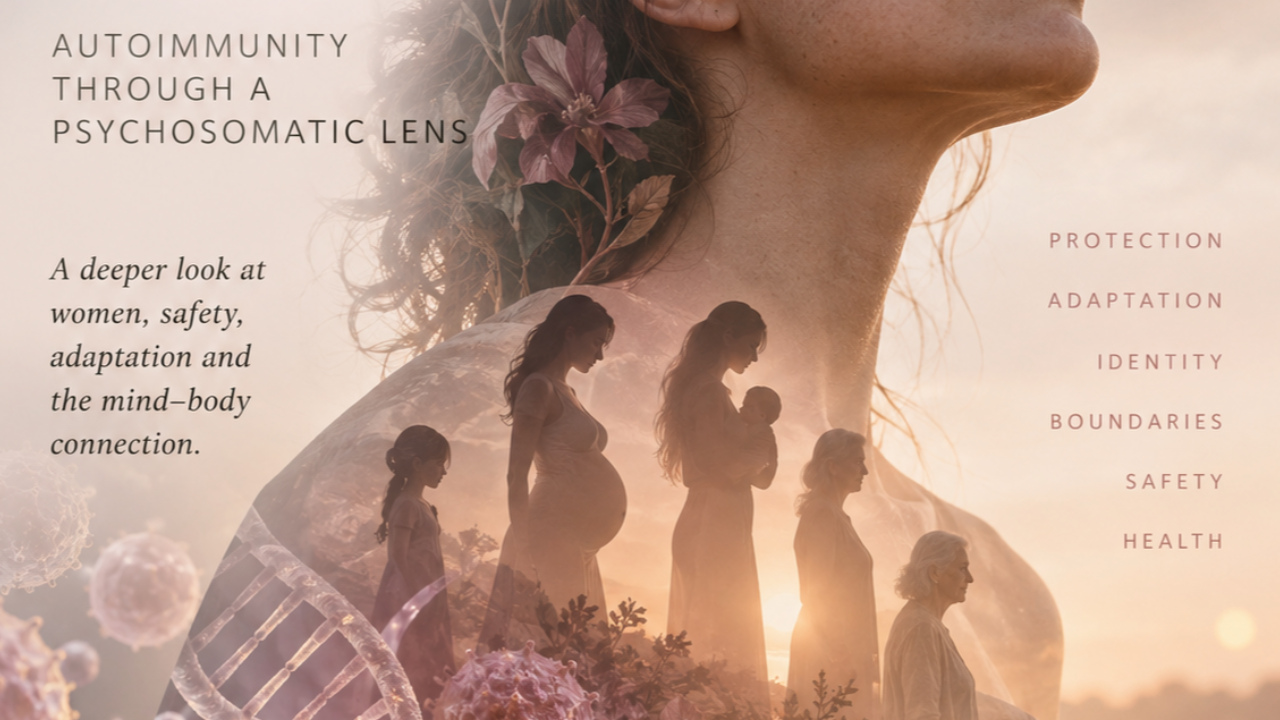
Author: Gillian Maddigan
September 2026
Does Her Body Know When It Is Safe?
Autoimmunity Through a Psychosomatic Lens
No wonder autoimmune disease is so commonly experienced by women.
Research shows there are biological reasons for this, including genetics, two X chromosomes, Xist, hormones and the naturally stronger and more reactive female immune response.
But when I look at this through my psychosomatic lens, I keep coming back to one word.
Safety
Women spend so much of their lives scanning and seeking safety. Emotionally, mentally, physically and energetically. Am I safe here? Can I speak? Can I say no? Can I relax? Do I need to protect myself?
And what does the body do with all that information?
A Body Built to Adapt
Think about what the female body is asked to do throughout a lifetime.
From conception, cells divide, replicate, and encode. Puberty arrives, and the body prepares for procreation. Hormones continually change the internal environment. Pregnancy, when it occurs, requires the body to grow and support a semi-foreign foetus without rejecting it. Then there is birth, recovery, continuing hormonal cycles, perimenopause and menopause.
Change ~ Adapt ~ Respond ~ Recalibrate
Again and again.
And all of this is happening while a woman is living her life.
She isn't simply a biological body undergoing cellular and hormonal changes. She is having experiences, forming relationships, developing boundaries, responding emotionally and physically, and learning what feels safe and what doesn't.
Recognition
This is where autoimmune disease becomes particularly interesting to me psychosomatically.
The immune system has an extraordinary job of recognition.
This is me. This isn't me.
This belongs. This doesn't.
This is safe. This needs a response.
Autoimmune disease involves that recognition becoming disrupted, with the immune system responding against the body's own tissues.
And my psychosomatic brain immediately becomes curious.
Who am I?
What is mine?
What have I taken on from somebody else?
Where do I finish and another person begin?
What do I allow in?
What do I keep out?
When do I protect myself?
And when can I stop protecting myself?
Problems or challenges with identity, boundaries or safety are not the only cause of autoimmune disease. The human body is far too complex for that.
I am asking what else we might learn when we place the biology alongside the woman's emotional anatomy and the life she has lived.
Because we come with our genetics. Then we have our circumstances and influences. And we react.
Genetics + Circumstance + Influences + Reaction.
Repeated reactions become familiar patterns. Familiar patterns can become automatic. Eventually, the conscious mind may no longer recognise the trigger, yet the body has already responded.
When Protection Becomes the Pattern
Women's immune systems are generally stronger and more reactive. That interests me because autoimmune disease isn't necessarily about a weak system. It can involve an incredibly responsive protective system becoming misdirected.
Protection itself isn't the problem.
Being vigilant can protect us. Boundaries protect us. Emotional reactions protect us. Pulling away, fighting or shutting down may all have served a purpose at some point.
So perhaps the question isn't simply:
Why did the body learn to protect itself?
Perhaps it is:
Does it still recognise when it is safe enough to stop?
For me, this is the psychosomatic conversation.
The biology matters. Genetics, chromosomes, hormones and immune function matter.
And so does the woman living within that changing biological environment.
Her circumstances. Her relationships. Her identity. Her boundaries. Her triggers. Her emotional and physical responses. Her history of adapting to the world around her.
Rather than beginning with, “What is wrong with her body?”
I become curious about:
“What has this woman's body spent a lifetime learning to recognise, adapt to, respond to and protect?”
Because with awareness and understanding, change becomes a choice.
References: Stanford Medicine on Xist, the review of sex differences in autoimmune disease and Garvan/UNSW research into sex differences in immune regulation
Join Gillian for a live 3-hour online training on Body Language Basic to understand what your body is communicating - https://www.psychosomaticsandemotionalanatomy.com/psychosomatic-body-language-basics
Author

Author
