
The Power of Relationship Circles
Author: Gillian Maddigan
October 2026
The Power of Relationship Circles
Lately, I have been reflecting on the many relationship circles I have moved through in my life.
I have been reconnecting with school friends, friends from my teenage years, colleagues, clients, students and people from social circles that belong to very different chapters of my life.
Some people I have seen almost daily. Others I may not have seen for years. Yet when we reconnect, there can still be something familiar there. A shared history, an old version of ourselves, a reminder of who we were at that particular time.
It has made me think about just how many people contribute to the person we become, and how differently we connect with each of them.
It was this reflection that led me to develop my Relationship Circles mini course.
I became curious about the different circles we move through during our lives. Why do some people remain deeply connected to us despite years apart, whilst others who are physically present in our lives may never really know us? Why do we give so much of ourselves to some relationships and very little to others? And why can one relationship leave us feeling energised and another leave us completely depleted?
Perhaps most interestingly, do we ever stop to consider what purpose a relationship is serving in our life now, rather than simply continuing it because it has always been there?
Some relationships ground us. Some challenge us. Some make us laugh. Some teach us about boundaries. Some bring out parts of our personality that don't appear anywhere else.
And some quietly exhaust us.
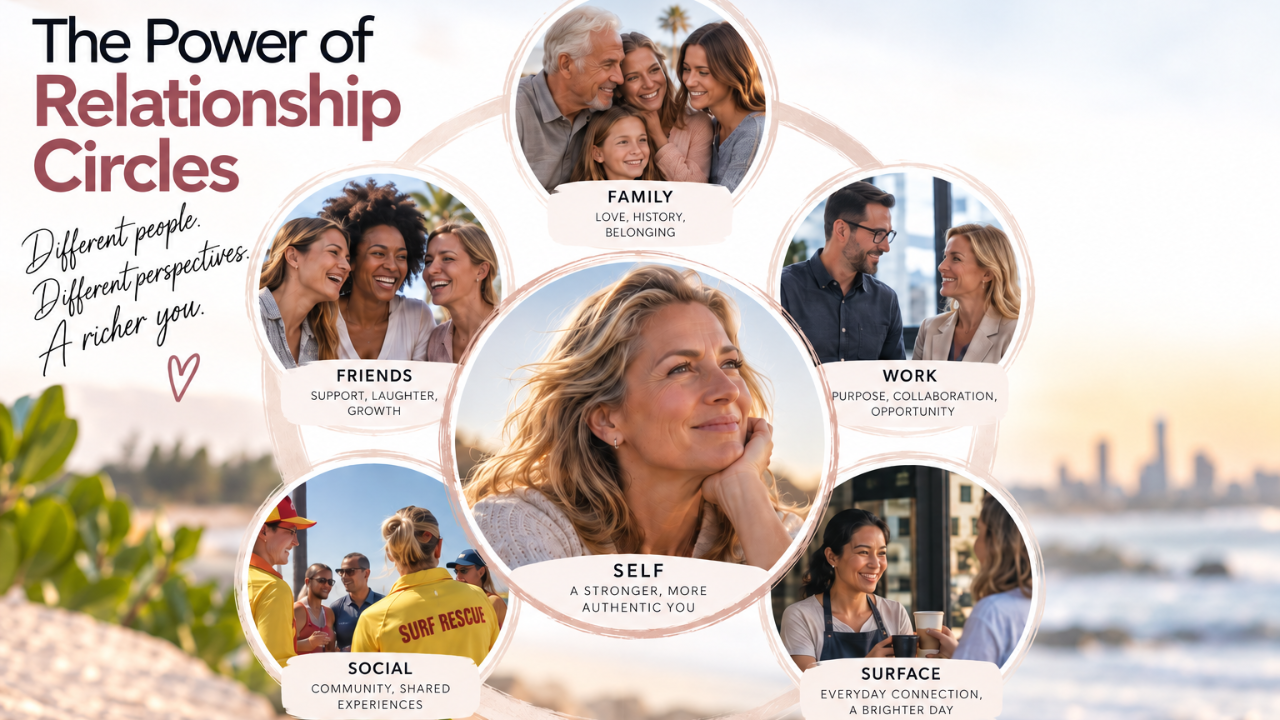
Through my work and my own life experiences, I have come to think of these different connections as relationship circles.
Family. Friends. Work. Social connections. The familiar people we encounter in everyday life. And, sitting at the centre of all of them, our relationship with ourselves.
Each circle can carry a different level of expectation, responsibility, emotional investment and energy.
And that is where it gets interesting.
We Don't Need the Same Thing From Everyone
A person we enjoy socially may never become a close friend. A work colleague may become someone important in our personal life. A friendship that once felt inseparable may gradually change as our lives move in different directions.
Sometimes we outgrow people. Sometimes they outgrow us. Sometimes nobody has done anything wrong. The relationship has simply changed.
And that's not necessarily a failure.
Perhaps its purpose has changed.
I think we can create a lot of emotional pressure when we expect a relationship to remain what it once was, or to maintain a level of connection that the other person simply doesn't share in the same way.
We can be standing in the same relationship and experiencing it very differently.
One person may consider someone a close friend whilst the other experiences the relationship as primarily social. One may be emotionally invested whilst the other is connected through a shared activity, workplace, history or circumstance.
Neither necessarily has to be wrong.
The difficulty can come from the expectation we attach to the relationship.
And then there are the relationships we maintain because of history.
We've known each other forever.
They're family.
I've always been the one they call.
That's just the role I play.
History can create connection, but it can also create obligation.
At what point do we stop relating from who we were and begin relating from who we are now?
When Our Circles Change
This is where relationships become particularly interesting to me from a psychosomatic perspective.
As we change, our relationships often change with us.
Our identity develops. Our boundaries shift. Our responsibilities change. What we are prepared to give changes. What we need from other people changes too.
Yet sometimes we continue relating from an old version of ourselves.
We stay:
- the helper
- the responsible one
- the peacekeeper
- the strong one
- the one who doesn't need anything
- the person who always says yes.
We may continue giving a relationship the same amount of emotional energy simply because that is what we have always done.
Then resentment creeps in.
Or exhaustion.
Or guilt when we try to say no.
Sometimes we don't immediately recognise that the relationship itself has changed because our role within it has become so familiar.
Rather than deciding whether a relationship is "good" or "bad", I think there is greater value in becoming curious about what happens within us when we are in that relationship.
Do I feel more like myself?
Do I automatically fall into an old role?
Can I speak honestly?
Do I feel responsible for keeping everybody happy?
Do I leave the interaction feeling connected, or do I leave feeling depleted?
Sometimes our emotional and physical responses tell us something before we have consciously found the words for it.
Not Everyone Needs Full Access to Us
One of the things I have come to appreciate is that not every person needs full emotional access to us for the relationship to have meaning.
There is value in the friend who has known us for thirty years.
There is also value in the person we pass while walking the dog who smiles and says hello.
There are relationships built around love and history, others around purpose, shared interests, community, laughter, work or simply familiarity.
They don't have to become something more to matter.
Perhaps some of our emotional exhaustion comes from expecting every relationship to provide something it was never designed to provide, or from continuing to give more of ourselves than that particular connection requires.
This also raises another question:
Does everybody in our lives need the same version of us?
I don't think they do.
Different relationships allow different parts of our identity and personality to be expressed. The person I am with an old school friend may not be exactly the same person I am with a client, colleague, family member or someone I have just met.
They are all still me.
They are simply different expressions of me within different circles of connection.
And Then There Is the Relationship With Self
At the centre of every one of these circles is the relationship we have with ourselves.
That relationship influences what we tolerate, what we give, where we establish boundaries and how we respond when those boundaries are challenged.
It also influences the roles we repeatedly take on.
This is where relationship circles become much more than simply looking at who is in our lives.
They become an opportunity to notice who we become when we are with them.
Where do I silence myself?
Where do I overgive?
Where do I feel completely comfortable being myself?
Where am I still looking for acceptance or validation?
And where might I be holding onto a relationship through obligation, guilt or history rather than a lively, healthy connection?
Those questions are not necessarily about ending relationships.
They are about understanding them.
Because sometimes growth means strengthening a relationship. Sometimes it means changing the way we engage. Sometimes it means establishing a boundary. Sometimes it means accepting that a relationship has completed its purpose.
And sometimes there is grief in that too.
Who Is in Your Circles?
Our relationship circles will continue to change as we do.
People will move closer, move further away, leave, return, or simply hold a different place in our lives.
Maybe we don't need to hold every relationship more tightly.
Maybe we need to become more aware of what it is, what it brings into our lives, what we bring to it, and whether the way we are relating still reflects who we are today.
That curiosity is what led me to develop the Relationship Circles mini course, where I explore these different circles more deeply and look at how they influence our identity, communication, boundaries, emotional investment and energy.
But before analysing any of that, perhaps there is a much simpler place to begin.
Think about the people in your life today.
The ones who have known you forever. The newer connections. The people you see every day. The ones you rarely see but immediately reconnect with. The people who energise you, challenge you, frustrate you, support you or remind you of another version of yourself.
Then ask yourself:
Do my relationship circles reflect who I was, who I am now, or who I am becoming?
And perhaps even more importantly:
Who am I when I am within each of them?
Author

Author
